Condux groups your production errors and alerts your team today. Its AI fix engine, the Conductor, opens a draft pull request that fixes the root cause, ready for your team to review and merge. Run it on our cloud in minutes, or self-host the source on your own infrastructure.
Works with your existing Sentry SDK. Just change the DSN.
Everything you expect from error monitoring
Ingest at scale
First-party SDKs for JavaScript, Python, Go, Ruby, PHP, Java and .NET, plus the Sentry envelope wire format and native OTLP logs. A stateless relay scrubs PII, rate-limits per plan, and buffers through Redpanda.
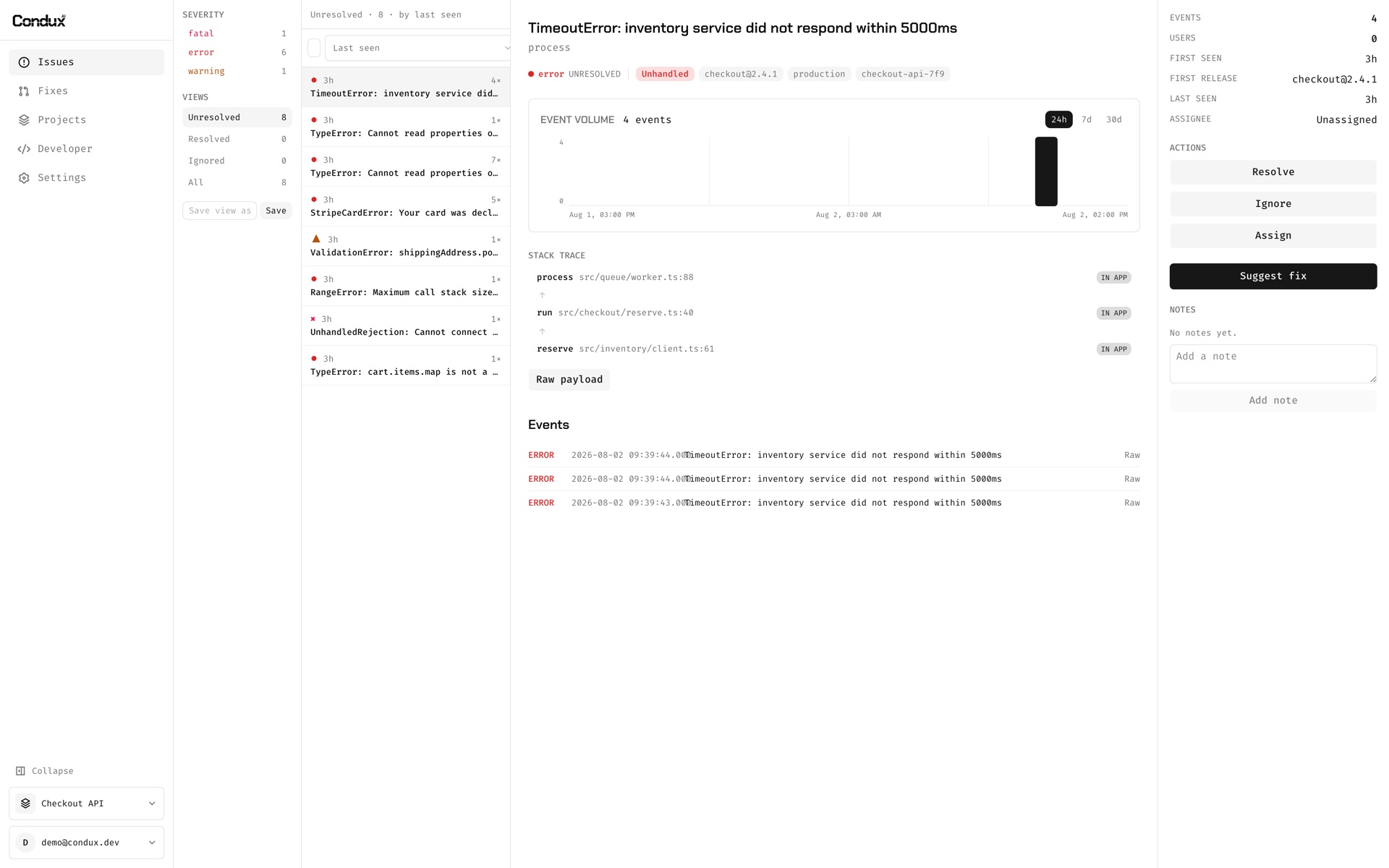
Events are fingerprinted by stack trace into deduplicated issues, so one bug is one issue, with exact counts and the first and last time it was seen.
Stack traces you can read
Upload source maps from your build and minified frames resolve back to the original file, line and function, with the surrounding code inline. Releases are tracked too, so an issue tells you which one it first appeared in.
Alerts that fit your flow
Rules fire on a new issue or a regression, above a severity you choose, to email, Slack, Discord or a webhook. They are evaluated the moment the event lands, and a weekly digest sums up the week for everyone else.
Vulnerable dependencies, fixed
Connect a GitHub repository and open advisories appear beside your errors, alongside the versions of that package our SDKs saw actually running. Where an advisory names a fixed version, the Conductor opens a dependency-bump draft pull request for review, on the same allowance as any other fix.
Multi-tenant orgs and projects, access control by role, and a fast issue list and detail view. Served same-origin with your data, on your infrastructure.
Bring your AI agent
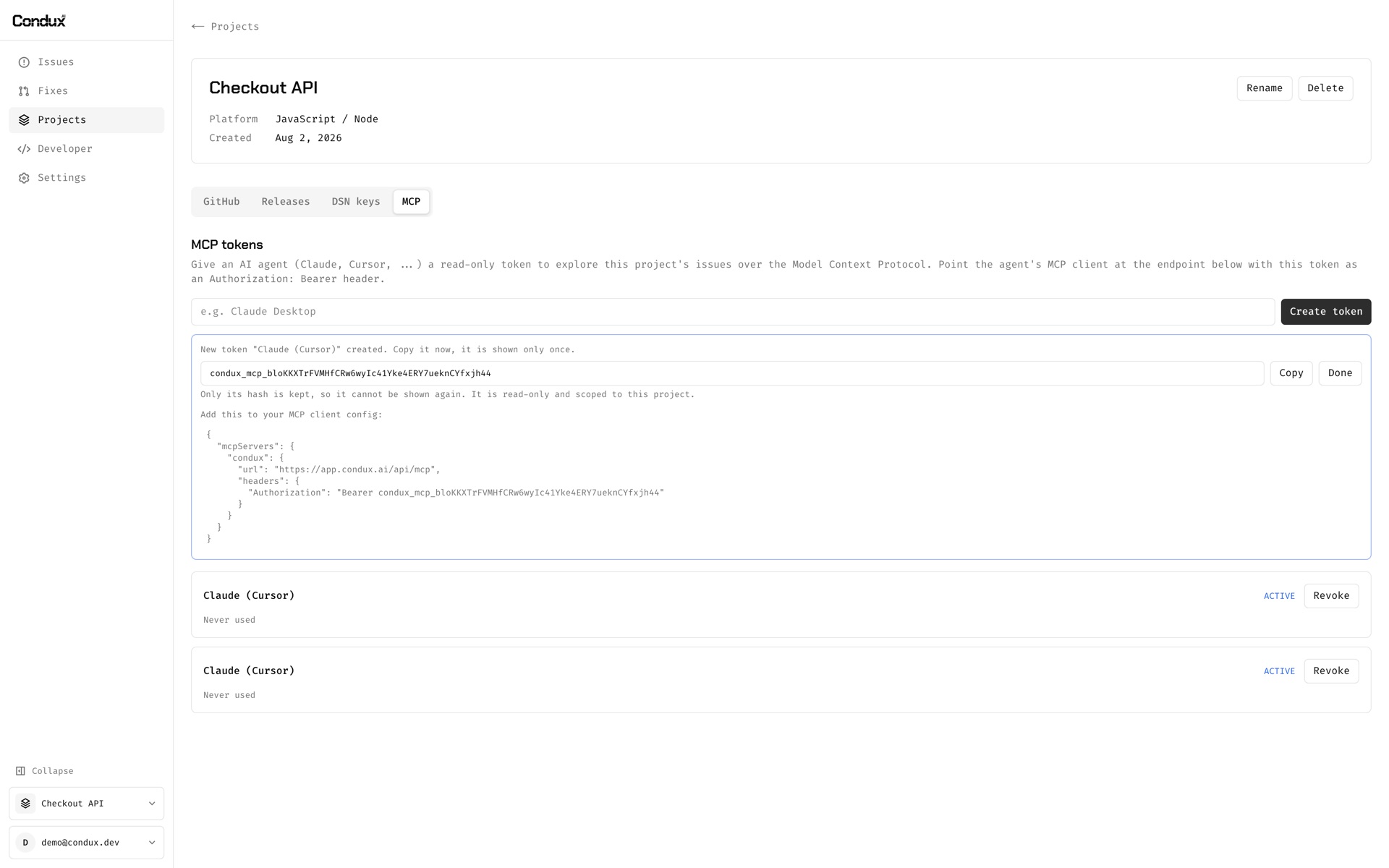
Point Claude, Cursor or any MCP client at a project with a scoped token. Your agent lists issues, reads a de-minified stack trace and pages through occurrences, so it debugs against real production errors, and can resolve one if you grant it triage.
A keyboard-first issue list: step through with j and k, resolve, ignore or assign the open issue without reaching for the mouse, and leave a note on anything worth explaining to whoever picks it up next.
The Conductor
Connect a repo. Get a fix, not just an alert.
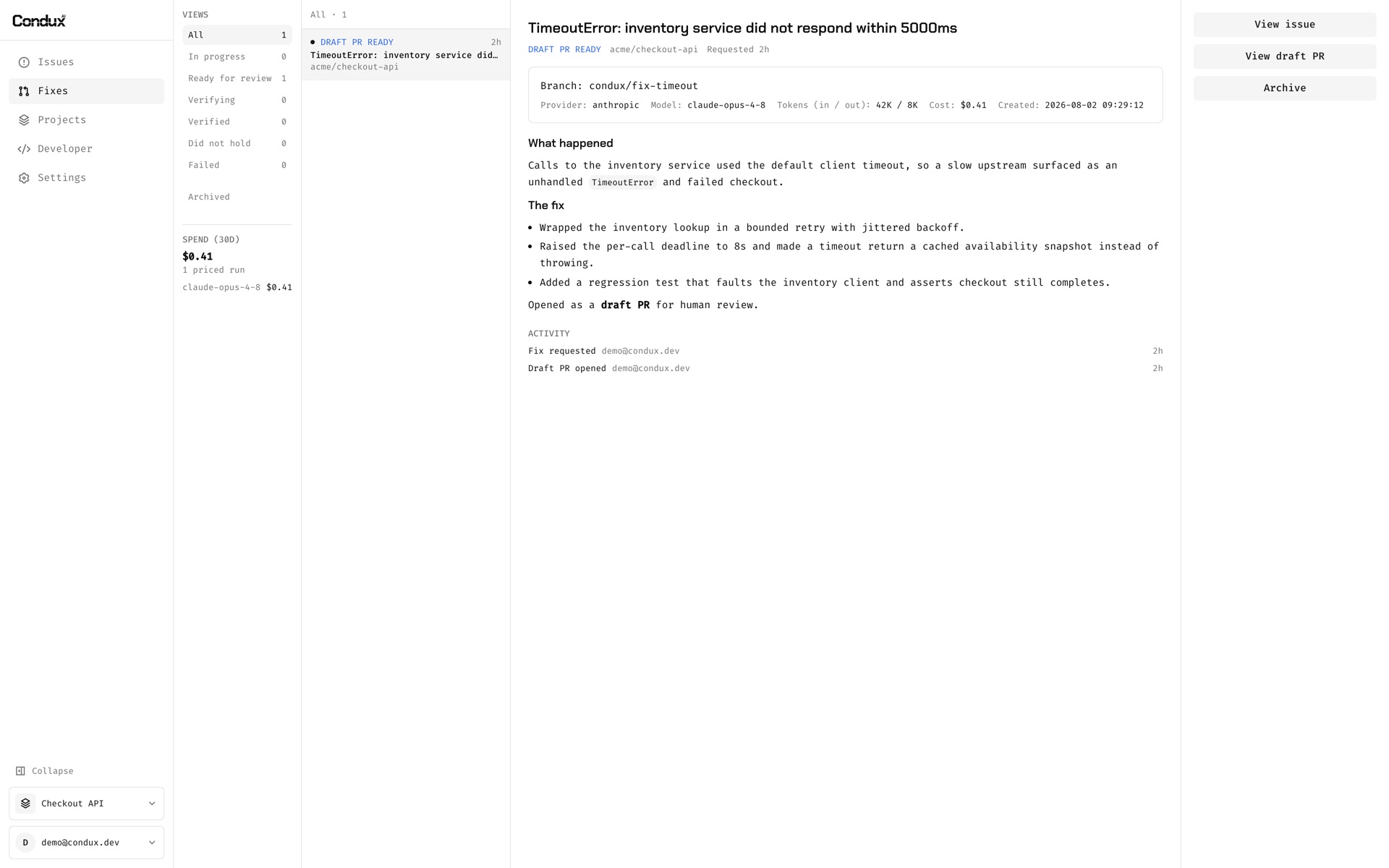
Link your repository and Condux maps each error to the exact code behind it, then opens the fix as a draft pull request authored by condux-ai[bot]. It is scoped to the files the stack trace touched, comes with a test and runs on your own model key. Your team reviews and merges. This is the safe half of Sentry meets Copilot.
Least privilege, always
A GitHub App with short-lived, installation-scoped tokens. Edits run in a sandbox and the git credential never enters it.
Never auto-merged
The Conductor only ever opens a draft PR. Your CI runs on it and a human reviews and merges. Nothing ships without you.
Your model, predictable spend
Bring your own LLM: Anthropic, OpenAI or a self-hosted endpoint (Bedrock and Vertex coming soon). See each fix's cost, set a monthly budget on your own key, and keep spend and data on your account.
Model Context Protocol
Hand your errors to your AI agent
Mint a project-scoped token and point Claude, Cursor or any MCP client at Condux. Your agent can list issues, read a stack trace and pull recent events, straight from your editor. Tokens are read-only unless you grant triage, which also lets your agent resolve an issue and leave a note saying what it changed. No fix allowance to burn either way, and always scoped to one project.
Open to read. Yours to run.
Condux is source-available. Read the code that handles your errors, self-host it on your own infrastructure at no cost, and keep your data in your boundary. The managed cloud is there when you would rather not run it yourself.